If you are trying to understand deforestation in Africa, start here: the continent loses about 3.45 million hectares of forest to other land uses each year. Farming and fuel demand are the main pressures.
This guide is part of our wider look at natural resource management in africa.
| Item | Value |
|---|---|
| Africa’s deforestation rate, 2015-2025 | 3.45 million ha per year |
| Africa’s deforestation rate, 2000-2015 | 4.08 million ha per year |
| Africa’s net forest loss, 2015-2025 | 2.96 million ha per year |
| Africa’s share of world forest area | 16 percent |
| Woodfuel share of African primary energy | An estimated 60% to 86% (except north African countries and South Africa) |
The forest figures come from the FAO’s Global Forest Resources Assessment 2025 and the energy figure from an FAO study on wood energy in Africa. Figures can change, so check the sources before you rely on them.
How much forest is Africa losing?
Africa has about 16 percent of the world’s forest area, out of a global total of 4.14 billion hectares in 2025. Deforestation there is high, though it is easing.
The FAO’s 2025 assessment says the continental deforestation rate fell from 4.08 million ha a year in 2000-2015 to 3.45 million ha a year in 2015-2025. Africa and Europe were the only regions where the rate rose between 1990-2000 and 2000-2015, in Africa’s case from 3.62 million to 4.08 million ha per year.
Deforestation and net forest loss are different measures. Net change is deforestation minus forest expansion, such as planting and natural regrowth, so Africa’s net loss is smaller.
- 1990-2000: 3.28 million ha net loss per year
- 2000-2015: 3.63 million ha net loss per year
- 2015-2025: 2.96 million ha net loss per year
Africa had the second-highest net loss of forest area in 2015-2025, with Eastern and Southern Africa and Western and Central Africa accounting for most of it. The fall in net loss was due mainly to the Democratic Republic of the Congo, where net loss dropped by about 0.5 million ha per year compared with 2000-2015.
What causes deforestation in Africa?
Forest is cleared where people need land and energy. The two pressures that matter most on the continent are farmland expansion and wood used for cooking and heating.
Farmland is one pressure. The FAO assessment describes deforestation as conversion of forest to other land uses.
Fuel is another. An FAO study estimates that woodfuels supply 60% to 86% of African primary energy, except in North Africa and South Africa. It also says woodfuel use accounts for 90 to 98 % of residential energy consumption in most of sub-Saharan Africa.
That same study warns that woodfuel data in Africa are very scarce and highly uncertain. Treat any single national or regional number with care.
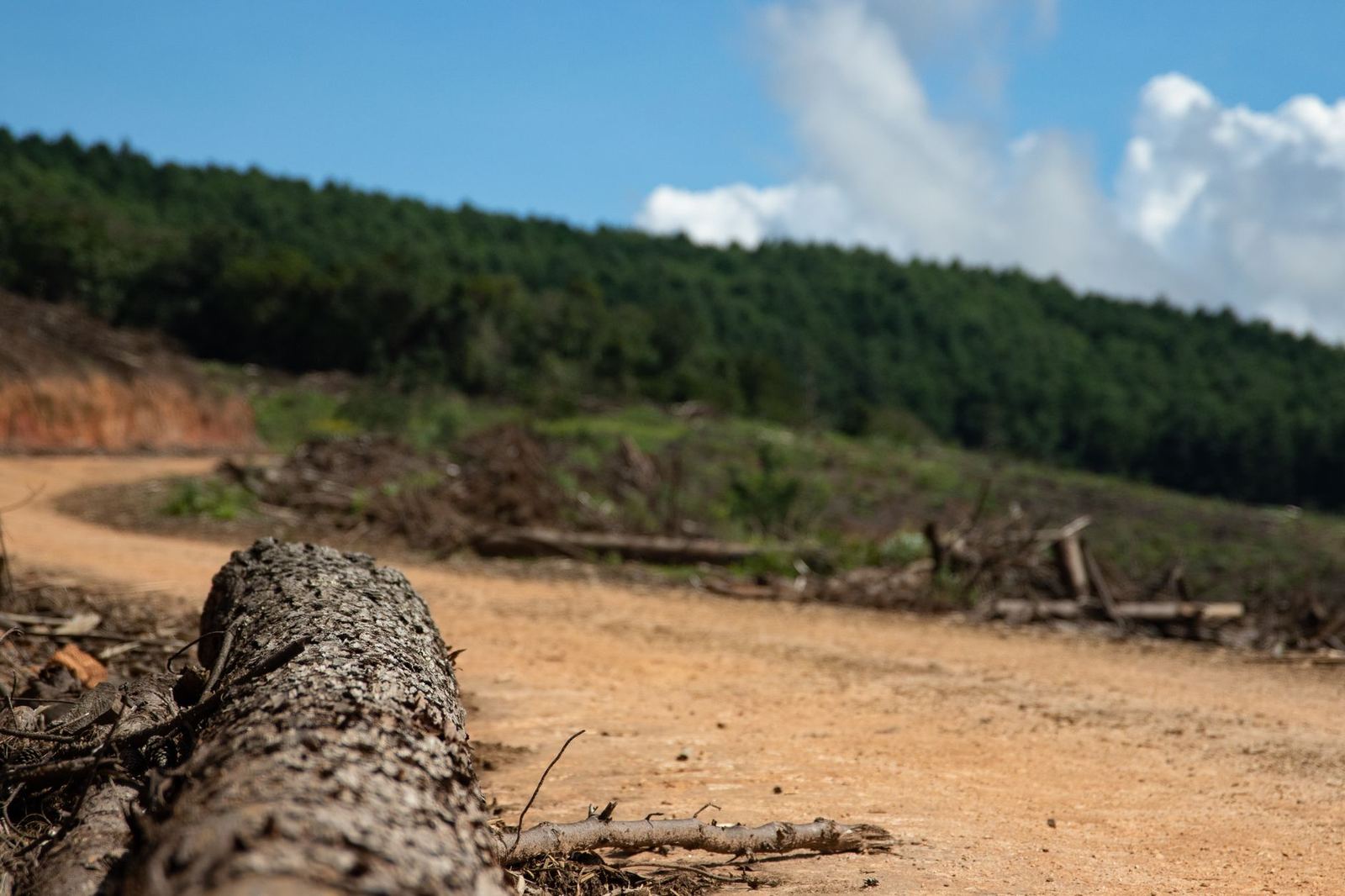
Where Africa sits in the global picture
Forest loss is concentrated in the tropics, and Africa is part of that belt. According to the FAO’s 2025 assessment, 88 percent of deforestation between 1990 and 2025 occurred in the tropical domain, which holds 45 percent of the world’s forests.
The tropical rate is falling. It went from 15.9 million ha per year in 1990-2000 to 11.9 million ha in 2000-2015 and 9.42 million ha in 2015-2025.
Africa’s own decline is slower than that and starts from a high base. Africa and Europe were the only regions where the rate rose in 2000-2015, so the recent fall to 3.45 million ha per year is a change of direction rather than a long trend.
Three points help you read these numbers:
- The figures are national reports compiled by the FAO, so data quality differs between countries.
- A small net loss can hide a large amount of clearing if planting or regrowth offsets part of it.
- Planted trees and tree orchards are not the same as natural forest. Africa reported 7.32 million ha of tree orchards in the 2025 assessment.
What are the consequences?
The first consequence is the loss of the forest itself, and with it the services that rural households draw from it. Fuel, building poles, wild foods and grazing are all taken from forests and woodlands.
Clearing also removes the tree cover that protects soil and holds water on slopes. Bare ground erodes faster and fields lose fertility, which can push farmers to clear still more land.
Agroforestry is one way out of that cycle, because trees stay on productive land. The FAO assessment reports that agroforestry area increased by 5.27 million ha between 1990 and 2025 in the 67 countries and areas that reported trend data, but decreased in Africa. That shows how much room there is to expand it.
The FAO study warns that thin woodfuel data make the effects of fuel use on forests hard to measure. Local observation therefore matters as much as national statistics.
How forest gain offsets forest loss
Forest area can also increase. The FAO assessment explains that it grows when trees are planted on land that previously was not forested, called afforestation, and when forest expands through natural succession on land that was under a different land use.
This is why the net figure for Africa, 2.96 million ha per year, sits below the deforestation figure of 3.45 million ha per year. The gap is the forest that was gained over the same period.
The offset has limits, because new or planted forest does not automatically replace the biodiversity, carbon and local uses of an older natural forest. A reader comparing countries should look at both measures, not only the net one.
For land managers and planners, that suggests two separate jobs:
- Slow the clearing of existing forest, which is the deforestation number.
- Support regrowth and tree planting, which is the expansion number.
Both matter, but only the first protects what is already standing.
What can reduce the pressure on forests?
No single fix works everywhere. The measures below address the main drivers.
- Give local people a real stake in forests. See our guide to community forest management for how this works.
- Cut demand for wood fuel with cleaner stoves and other fuels, as covered in our piece on fuelwood and charcoal alternatives.
- Raise yields on existing farmland so families need less new land.
- Keep trees on farms through agroforestry.
- Improve data, since weak woodfuel statistics make planning hard.
The FAO study notes that woodfuels are likely to remain the major energy source in Africa and, with the exception of a few countries, are slowly being replaced by LPG or other energies. Progress on substitution is therefore likely to be gradual.
Frequently asked questions
How much forest does Africa lose each year?
Show answer
The FAO’s 2025 assessment puts deforestation at 3.45 million ha per year for 2015-2025. Net loss, after counting forest gain, was 2.96 million ha per year.
Is deforestation in Africa getting better or worse?
Show answer
It has slowed. The deforestation rate fell from 4.08 million ha per year in 2000-2015 to 3.45 million ha per year in 2015-2025, though it remains high.
What is the difference between deforestation and net forest loss?
Show answer
Deforestation is forest converted to other land uses. Net loss subtracts forest expansion from it, so the net figure is lower.
Why does woodfuel matter for forests?
Show answer
An FAO study estimates woodfuels supply 60% to 86% of African primary energy, except in north African countries and South Africa, so fuel demand puts steady pressure on trees.