Wondering what is agroforestry and whether it fits your land? It is farming that deliberately grows trees with crops or livestock on the same ground, so each helps the other.
| Item | Value |
|---|---|
| What it is (FAO) | Land management that intentionally integrates trees, crops and/or animals |
| Typical payback, agroforestry (FAO) | 3-8 years on average |
| Typical payback, annual cropping (FAO) | 1-2 years |
| Faidherbia albida maize gain under canopy, Malawi (2009 release) | Up to 280 percent |
| Faidherbia albida area in Niger (2009 release) | Over 4.8 million hectares |
| Farmers growing it on maize fields, Malawi and southern Tanzania (2009 release) | Half a million |
These figures come from the FAO agroforestry FAQ and a 2009 World Agroforestry Centre news release. They can change, so check the sources before you rely on them.
This site is independent and educational. It is not connected to FAO, the World Agroforestry Centre or any other body named here, and it offers no services or consulting.
What is agroforestry, in plain terms?
The FAO puts it simply: agroforestry systems are “land management practices that intentionally integrate trees, crops, and/or animals.” The word that matters is “intentionally”. A few trees left standing in a field by accident are not a system; trees chosen, placed and managed for a purpose are.
That purpose can be many things. A tree might feed the soil, shade cattle, supply fuelwood, yield fruit, mark a boundary or slow the wind. Good designs usually serve several of these at once.
Agroforestry is not forestry and it is not ordinary cropping. It sits between them, and its logic is to use the same plot in layers: roots at different depths, canopies at different heights, and products arriving in different seasons.
Why the idea matters in Africa
Many African farms are small, rain-fed and short of purchased inputs. The 2009 World Agroforestry Centre release noted that African farmland is severely degraded and that farmers apply, on average, only 10 percent of the soil nutrients used in the rest of the world. Trees that return nutrients to the soil are therefore a practical answer, not a luxury.
For the regional picture, see our guide to agroforestry in africa. Agroforestry is also one tool among several in the wider field of natural resource management in africa.
How do trees and crops help each other?
Trees and crops can work together because they use space and time differently. When the match is right, the tree gives more than it takes. When it is wrong, the tree competes with the crop for light and water.
The main ways trees help are:
- Feeding the soil: leaf litter, root turnover and, for some species, nitrogen fixation.
- Protecting the ground: roots and canopy hold soil in place and soften rain impact.
- Shade and shelter: cooler air and less wind for crops and animals.
- Extra products: fodder, fruit, timber, poles and firewood.
- Carbon storage: the FAO states that trees planted and grown in agroforestry systems contribute carbon sequestration.
The FAO also lists benefits for farm families: less need for external inputs, more diverse production and income, and greater resilience to shocks and stresses. Those are claims about well-planned systems, not guarantees for every farm.
Where the trade-offs sit
Every tree on a field takes some space. Shade can cut yields if the species or spacing is poor, and roots can reach into the crop zone. Pruning, spacing and species choice are the tools that manage this.
The FAO makes a related point about outcomes: systems that successfully integrate agroecology can improve short, medium and long-term outcomes for farmers. Design matters as much as the decision to plant trees.
What are the main types of agroforestry systems?
Systems are usually grouped by what the trees are combined with. Agrisilvicultural systems pair trees with crops, silvopastoral systems pair trees with livestock, and agrosilvopastoral systems combine all three. Our overview of the types of agroforestry systems covers the full range.
The common practices you will meet are these:
- Improved fallows: the FAO describes these as woody species planted and left to grow during fallow.
- Alley cropping (hedgerow intercropping): in the FAO’s words, woody species in hedges, with agricultural species in the alleys between them.
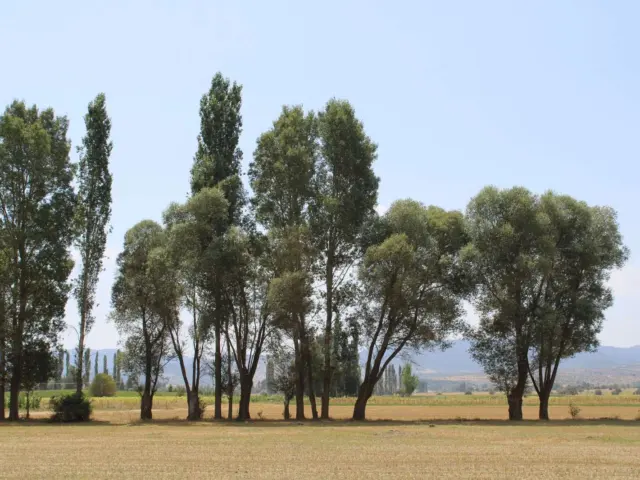
- Parkland systems: scattered, mature trees in cropped fields, long familiar across the Sahel and savanna.
- Silvopasture: trees managed together with grazing animals.
- Windbreaks and shelterbelts: rows of trees that cut wind across fields.
- Multi-layer tree gardens: many species grown in several layers, as in a home garden.
Alley cropping and improved fallow
In alley cropping, hedgerows of fast-growing trees are pruned regularly. The clippings are spread on the soil as mulch or green manure, and crops grow in the strips between.
An improved fallow works on a different rhythm. Instead of resting land under natural weeds, a farmer plants selected trees or shrubs, lets them grow for a season or more, and then clears them before cropping. The aim is to restore fertility faster than a natural fallow would.
Livestock and wind protection
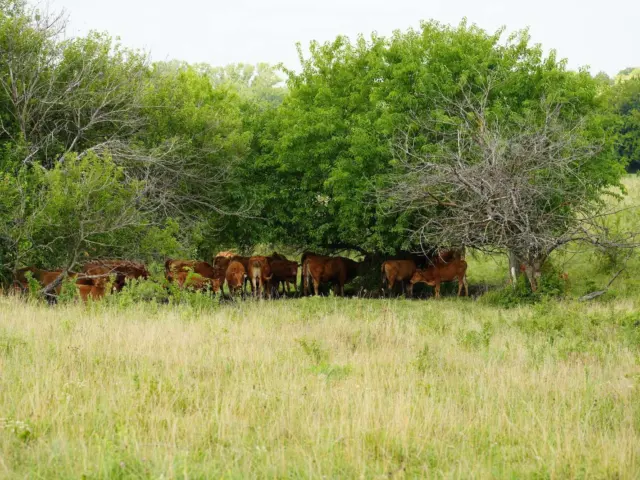
Trees and animals share land in silvopasture. Trees can give shade, shelter and fodder, which matters in hot and dry seasons when grass is thin.
Rows of trees can also protect the land itself. The design and upkeep of windbreaks and shelterbelts are covered separately.
How does agroforestry improve soil?
Soil is the main reason many farmers try trees. The FAO lists enhanced soil health and water management among the environmental benefits, and it names reduced soil and wind erosion among them too. Trees return organic matter through leaves, twigs and roots, and that organic matter feeds the soil life that makes nutrients available.
A tree canopy also slows rainfall before it hits the ground, and roots bind the surface. This is why trees are often planted on slopes and along contours. Our page on agroforestry benefits for soil goes into the mechanisms in more detail.
Nitrogen-fixing trees
Some trees host bacteria in root nodules that capture nitrogen from the air. When their leaves fall or are pruned and spread on the field, part of that nitrogen reaches the crop. Nitrogen fixing trees are therefore a core tool where mineral fertilizer is costly or hard to get.
Not every nitrogen-fixing species suits every site. Rainfall, soil type, crop and the labour available for pruning all affect the choice.
A closer look at Faidherbia albida
One of the best-known African examples is the acacia tree faidherbia albida. It has what the 2009 World Agroforestry Centre release calls “reverse leaf phenology”: it goes dormant and sheds its nitrogen-rich leaves during the early rainy season, when seeds are being planted and need the nitrogen. It then regrows its leaves when the dry season begins and crops are dormant.
Because its leaf cycle runs opposite to the crop’s, it casts little shade when the crop needs light. That timing is the reason it is often called a fertilizer tree.
The release gave these reported figures, as of its August 2009 date:
- In Malawi, maize yields were increased up to 280 percent in the zone under the tree canopy compared with the zone outside it.
- Half a million farmers in Malawi and the southern highlands of Tanzania grow the tree on their maize fields.
- The tree is growing on over 4.8 million hectares of land in Niger.
Treat the 280 percent as an upper figure from specific sites, not an average. Results depend on soil, rainfall, tree density and management.
What does agroforestry cost, and how long until it pays?
Trees take time. The FAO says that on average, agroforestry sees profitable returns after 3-8 years, while annual cropping systems normally see profits within 1-2 years. That gap is one of the main reasons farmers hesitate.
The FAO also says risk perception and risk management are some of the main barriers to agroforestry. It links many barriers to weak enabling environments: secure land tenure, supportive policies and incentives, available extension services, and access to markets and value chains.
Ways farmers manage the wait
Some practical approaches reduce the lean years. They are common-sense design choices rather than figures from a study:
- Start with fast-yielding species or those that give fodder or fuelwood early.
- Keep annual crops growing between young trees while the canopy is small.
- Plant a small area first and expand once it works on your soil.
- Choose trees with several uses, so one product can carry the others in a poor year.
Land tenure matters here. A person who cannot be sure of using the land for the long term has little reason to plant a tree that pays back slowly.
How does agroforestry differ from ordinary farming and forestry?
In ordinary annual cropping, the field is cleared and replanted each season. Everything above ground is short-lived, and the soil is bare for part of the year. The FAO lists reduced need for external inputs among the benefits of agroforestry.
In agroforestry, a woody perennial stays in place season after season. Its roots keep working between harvests, and in many species the canopy helps protect the ground. This is why the system tends to buffer the farm against shocks, a point the FAO raises when it lists resilience to shocks and stresses among the socioeconomic benefits.
Plantation forestry sits at the other end. It grows trees for one main product and usually leaves little room for food crops. Agroforestry, by contrast, aims to combine trees with food, fodder and soil care on the same land.
A mixed system spreads risk
A farm that depends on one crop is exposed when that crop fails. A farm with maize, fodder trees and a few fruit trees has several things to sell, eat or feed to animals. If drought hits the maize, the deep-rooted trees may still produce.
This does not remove risk. It shifts the farm from one large bet to several smaller ones, which many households find easier to live with.
Which trees and shrubs are used?
There is no standard list, because the right tree depends on rainfall, soil, altitude and what the household needs. Farmers and extension workers usually sort species by the job they do.
- Fertilizer trees and shrubs: legumes that fix nitrogen and drop nutrient-rich leaves.
- Fodder trees: species whose leaves or pods feed cattle, goats and sheep.
- Fruit and nut trees: mango, citrus, avocado and similar crops that bring in food and cash.
- Timber and pole trees: species grown for building and fuel.
- Boundary and shelter trees: tough, fast-growing species for hedges and windbreaks.
Native species deserve first consideration. They are already adapted to local conditions and often support more wildlife. Exotic species can grow fast, but some spread where they are not wanted, so seek local advice before planting them widely.
Matching tree to crop
Crops differ in how much shade they tolerate. Maize and many cereals want plenty of light, while coffee and cocoa often do better under partial shade. A good match gives the crop the light it needs at the time it needs it.
Timing is the clever part of designs like the Faidherbia parkland, where the tree is leafless while the crop grows. Other designs rely on pruning to the same effect, cutting branches back before planting so that light reaches the young crop.
What goes wrong, and how do farmers avoid it?
The FAO identifies risk perception, risk management and weak enabling environments among the main barriers to agroforestry. A few repeated problems are worth knowing about before you plant.
- Wrong tree for the site. A species that thrives in a wet valley may die on a dry slope. Check what grows well nearby.
- Trees planted too close. Crowded trees compete with each other and with crops. Leave room for the mature canopy, not the seedling.
- No protection for seedlings. Browsing animals, fire and drought kill young trees. Fencing, mulch and watering in the first dry season help.
- Neglected pruning. Hedgerows that are not cut back shade the crop. Pruning is a regular job, not a one-off.
- Unclear ownership. If it is unclear who owns the trees or their products, conflict follows. Settle this early.
The FAO’s barriers list backs up the last point, naming secure land tenure first among the enabling conditions. Where tenure is weak, farmers often will not invest in trees that outlast a single season.
Labour and knowledge
Tree work is spread across the year rather than concentrated at planting and harvest. Pruning, mulching and tending seedlings add to a busy calendar, especially for households short of labour. Farmers often weigh this against the savings on fertilizer and fuel.
Knowledge also takes time to build. Visiting a neighbour’s established plots and learning from farmer groups is often more useful than any leaflet, since it shows how a design behaves on local soil.
How to start thinking about a system for your land
There is no single correct design. A useful way to begin is to name the problem you most want solved, then match a practice to it.
- Tired soil and costly fertilizer: look at nitrogen-fixing trees, improved fallow or a fertilizer tree parkland.
- Erosion on slopes: consider hedgerows along contours.
- Wind damage or drying winds: consider shelterbelts.
- Hungry livestock in the dry season: consider fodder trees or silvopasture.
Then check which species already thrive nearby, because local trees are adapted to local rainfall and soils. Ask neighbours and local extension staff what has worked, and observe existing parkland trees before planting new ones.
A simple planning routine
Walk the land in the rainy season and again in the dry season. Note where water runs, where soil is thin, where the wind hits and where animals gather. These observations tell you more than any general rule.
Next, list what the household needs from trees: food, fodder, fuel, income or soil repair. Rank them, because a design that tries to do everything usually does nothing well.
Then start small. Plant a trial plot, watch how crops and trees interact through at least one full cycle of seasons, and adjust the spacing, species or pruning before you expand. Because the FAO notes that payback can take years, early observation helps you avoid expensive mistakes.
Keeping records
Write down planting dates, species, spacing and what happened. Even simple notes on crop yield beside the trees and away from them will show whether the system is working. Over several seasons these records become your own evidence, tuned to your soil and rainfall.
Frequently asked questions
What is agroforestry in one sentence?
Show answer
It is land management that intentionally integrates trees, crops and/or animals, according to the FAO.
Is agroforestry the same as planting a forest?
Show answer
No. The trees share land with crops or livestock, so the plot still produces food or fodder while the trees grow.
How long before agroforestry pays off?
Show answer
The FAO says profitable returns come after 3-8 years on average, against 1-2 years for annual cropping. Fast-yielding species and intercropping can soften the wait.
Does Faidherbia albida really raise maize yields?
Show answer
A 2009 World Agroforestry Centre release reported maize yields up to 280 percent higher under the canopy in Malawi. That is a best-case figure, so expect results to vary by site.