Tired soil on your farm? The agroforestry benefits for soil are real: trees add organic matter, recycle nutrients and shield the surface from runoff. Studies show richer soil and higher yields near trees.
New to the idea? Start with what is agroforestry, then come back here for the soil side of the story.
| Item | Reported value |
|---|---|
| Soil organic carbon under tree canopy vs open area | +46% |
| Total soil nitrogen under tree canopy vs open area | +50% |
| Maize yield under tree canopy vs open area | +150% |
| Maize yield after two-year sesbania fallow, over unfertilised maize | 170-200% higher |
The canopy figures come from a meta-analysis of Faidherbia albida trees, the fallow figure from a study in eastern Zambia. Results vary by site and science gets updated, so check the sources before you rely on any number.
What trees do for the soil underneath them
A tree works on soil in several ways at once. Its leaves and twigs fall and rot, adding organic matter that feeds soil life and helps hold water and nutrients.
Deep roots reach layers that annual crops cannot, and the nutrients they pull up return to the surface as litter. Roots and canopy also protect the ground from the direct force of rain.
These effects are not magic, and they are not the same for every species. A tree that drops nutrient-rich leaves at the right time helps crops. A heavy shader or a competitor for water can do the opposite, so species choice matters as much as the decision to plant.
Healthy soil is more than nutrients. It has crumbly structure, living organisms and the ability to take in rain instead of shedding it. Trees support all three, which is why farmers and researchers treat them as a long-term investment in the ground rather than only a source of fruit, fodder or wood.
The sections below separate what the studies actually measured from what is simply plausible. Where a figure covers a wider group of practices than agroforestry, the text says so.
- Litter: leaves, twigs and roots build organic matter.
- Roots: they recover nutrients from deeper soil and open channels for water.
- Cover: canopy and leaf litter slow raindrops and keep the surface from sealing.
- Nitrogen: some species host bacteria that fix nitrogen from the air.
Agroforestry benefits for soil fertility under the canopy
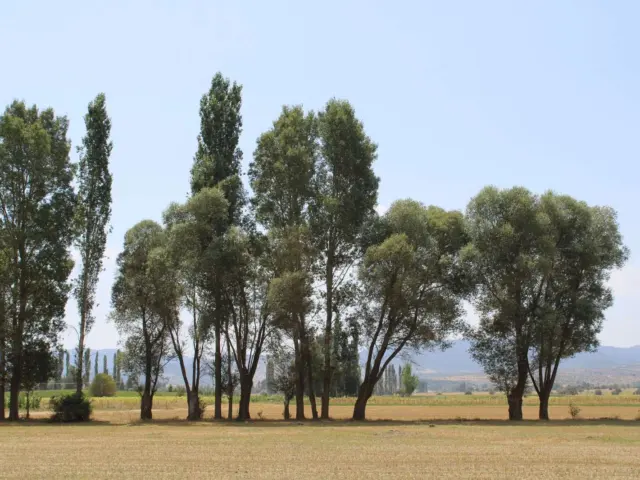
One of the clearest datasets comes from studies of Faidherbia albida, a tree widely grown in African cropland. A meta-analysis of those studies found significant increases in soil organic carbon (by 46%), total nitrogen (50%), phosphorus (21%) and potassium (32%) under the tree canopy compared with the open area.
The same analysis found yield gains for the crops grown there: 150% for maize and 73% for sorghum. The authors also reported that the tree created predictable patterns in soil nutrients and crop yields, consistent with distance-decay models of spatial interaction. In plain terms, soil nutrients and yields follow a pattern that changes with distance from the tree.
This is a practical point for layout. Scattered trees give patches of improved soil, so spacing and density decide how much of a field benefits.
Poor soils gain the most
The same meta-analysis reported that large increases in crop yields occurred in suboptimal conditions for crop productivity, more than in optimal conditions. That suggests trees matter most where soils are already degraded or inputs are scarce.
On a farm with fertile, well-fed fields, expect smaller gains. On worn-out plots, trees may be among the cheaper ways to rebuild fertility.
Nitrogen: fallows and fixing trees
Nitrogen is often the nutrient that runs out first under repeated maize. Some trees and shrubs fix it, which is why nitrogen fixing trees feature so often in soil-building plans.
A planted rest period is one way to use them. A study in eastern Zambia tested two-year plantings of Sesbania sesban and Cajanus cajan against natural fallow and continuous fertilised or unfertilised maize. It reported that the improved soil conditions and nitrogen contribution of the fallows to the following maize crop were shown by maize yields between 170-200% over maize without fertilizer.
The researchers also found that maize yields were significantly correlated with preseason nitrate nitrogen and total inorganic nitrogen in the top 20-cm soil layer. So the yield jump tracks measurable nitrogen in the soil, not just a vague “rest” effect. Our guide to improved fallow explains how the practice is set up.

Protecting soil from erosion and runoff
Fertility only helps if the topsoil stays put. A meta-analysis of conservation practices, including agroforestry, cover cropping, no-till, reduced tillage and residue return, found that across all practices surface runoff and erosion had mean decreases of 67% and 80% compared with controls. You can read the abstract on the Virginia Tech repository.
That figure covers the whole group of practices, not agroforestry alone. The same abstract notes that cover cropping gave the largest decreases, which it ties to the importance of maintaining continuous vegetative cover on soils. It also found that coarse- and medium-textured soils had greater decreases in erosion and runoff than fine-textured soils.
The lesson for tree planting is to think about cover. Trees help most when something also protects the ground between them, such as ground cover, mulch or residues.
Getting the benefits on your own land
Results depend on the tree, the soil and the rainfall, so start small and observe. These steps are a sensible order for most smallholders.
- Look at your problem first: is it low nitrogen, erosion on a slope, or hard, crusted ground?
- Pick species suited to that problem and to local conditions, ideally ones neighbours already grow successfully.
- Plant a trial block rather than the whole farm, and keep an unplanted comparison strip.
- Compare crop growth and soil surface condition near and away from the trees over several seasons.
- Keep the ground covered between trees with residues or mulch.
Keep records as you go. A simple notebook with planting dates, tree species, rainfall and harvest weights from the near-tree and away-from-tree strips will tell you more about your own soil than any average from a distant study.
Ask neighbours and local extension staff what has worked nearby, and share what you learn. Soil improvement is slow, so a shared record across several farms builds knowledge faster than one plot alone.
Be honest about trade-offs. Trees take land, water and time, and young trees give little at first. The studies above show strong averages, but your own field may behave differently.
Frequently asked questions
What are the main agroforestry benefits for soil?
Show answer
Trees add organic matter, recycle nutrients from deeper layers, can fix nitrogen, and help protect the surface from erosion. Under Faidherbia albida canopies, a meta-analysis found higher soil organic carbon, nitrogen, phosphorus and potassium than in open areas.
Do all trees improve soil?
Show answer
No. The effect depends on the species, its age, spacing and the local climate. Some trees compete with crops for water and light, so choose species with a proven record in your area.
How fast do soils improve?
Show answer
It varies. In the Zambian fallow study, trees were planted for two years before maize was grown. The fallow maize yields were also tied to measurable soil nitrogen in the top 20-cm layer.
Does agroforestry stop erosion completely?
Show answer
No. A meta-analysis of conservation practices that included agroforestry found a mean 80% decrease in erosion, which is a large reduction but not elimination. Cover on the ground between trees still matters.